The science that
kills the fire
at its source
Traditional extinguishers fight fire by removing one corner of the fire triangle. The Fire Safety Stick goes further — it adds a fourth dimension, using potassium ion aerosol chemistry to chemically interrupt combustion at a molecular level. Faster. Cleaner. More effective across every fire class.


Traditional extinguishers
create their own damage
Most fire extinguishers were designed decades ago. They fight fire — but the methods they use cause significant collateral damage of their own.
Beyond the fire triangle —
the fourth dimension
(foam = oxygen, water = heat)
the fire extinguishes itself
Every fire requires three components: heat, fuel and oxygen. This is the classic fire triangle — and most extinguishers work by removing one of those three sides. Foam removes oxygen access. Water removes heat. CO₂ displaces oxygen.
This approach works, but it is reactive and physical. It requires the extinguishing agent to overwhelm the fire before the fire can overcome it.
The Fire Safety Stick introduces a fourth dimension — the combustion chain reaction. Fire is not simply three elements in contact. It is an ongoing, self-sustaining chemical chain reaction between free radicals produced by combustion. Interrupt that chain reaction and the fire cannot sustain itself regardless of the presence of heat, fuel and oxygen.
This is the principle of chemical inhibition — and it is what the Fire Safety Stick's potassium ion aerosol technology is designed to do at a molecular level.
Chemical inhibition is faster and more complete than physical suppression. The potassium ions intercept combustion free radicals throughout the fire's volume — not just at the surface. This is why the Fire Safety Stick is effective across multiple fire classes with a single, compact device.
From activation to
fire out — in seconds
The Fire Safety Stick contains no gas and is not pressurised. The aerosol jet is produced only when the device is activated — a stable solid compound that transforms on contact with combustion.
What actually happens
inside the device
The Fire Safety Stick contains a stable solid compound composed of Potassium Nitrate (KNO₃), an organic oxidiser and a plasticiser resin. This compound is chemically inert at room temperature and requires no pressurisation to store safely.
When activated, the KNO₃ undergoes a rapid decomposition reaction inside the body of the device. This produces a controlled aerosol made up primarily of free potassium radicals (K⁺) and nitrogen gas.
The K⁺ radicals possess strong inhibitor qualities due to their weak ionisation energies. They are highly reactive with the combustion free radicals that sustain a fire — intercepting and neutralising them before they can propagate the chain reaction further.
Potassium has long been known to fire scientists as one of the most effective chemical inhibitors of combustion. The Fire Safety Stick's technology harnesses this property in a compact, deployable, maintenance-free format for the first time.
2 KNO₃ → 2 KNO₂ + O₂ K⁺ ions released into aerosol state K⁺ + OH• (combustion radical) → KOH Chain reaction neutralised → fire extinguishes After the Fire Safety Stick has extinguished a fire, only three things are released — all environmentally benign:
Watch the technology
perform under fire
Fire Safety Stick — Aerosol Inhibition Technology demonstration
Technique makes the
difference
The Fire Safety Stick discharges a gas — not a powder or liquid. The technique for using a gas extinguisher differs from traditional methods. Understanding the principles makes it significantly more effective.
The goal is to create a cloud of containment around the fire. The aerosol gas is heavier than air and will fill voids and enclosed spaces, making it especially powerful in areas like engine bays, enclosed machinery and tight spaces where direct contact is difficult.
The long discharge time — up to 100 seconds on the commercial version — is a deliberate design advantage. Use it. The extended discharge allows you to progressively close the cloud around the fire source rather than rushing the process.
One device. Every
major fire class covered.
Most traditional extinguishers are rated for one or two fire classes. The Fire Safety Stick covers all five — in a single compact device that weighs 215g and never needs servicing.
The science is proven.
The question is where yours is.
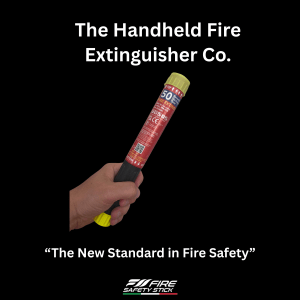
The Fire Safety Stick is available in 50-second and 100-second versions — compact enough for a car glove box, powerful enough for a commercial kitchen or engine bay.
Shop the Fire Safety Stick → Speak to the Team