How Fire Safety Stick Works - Aerosol Inhibition Technology
"The Fire Safety Stick is often called revolutionary, but its power lies in simple, clean science. Unlike traditional methods that rely on smothering a fire with toxic powder or messy foam, the Fire Safety Stick uses an advanced aerosol-based inhibition technology. This maintenance-free fire suppression system works by chemically interrupting the fire at a molecular level, providing a fast, residue-free fire safety solution for multiple fire classes."
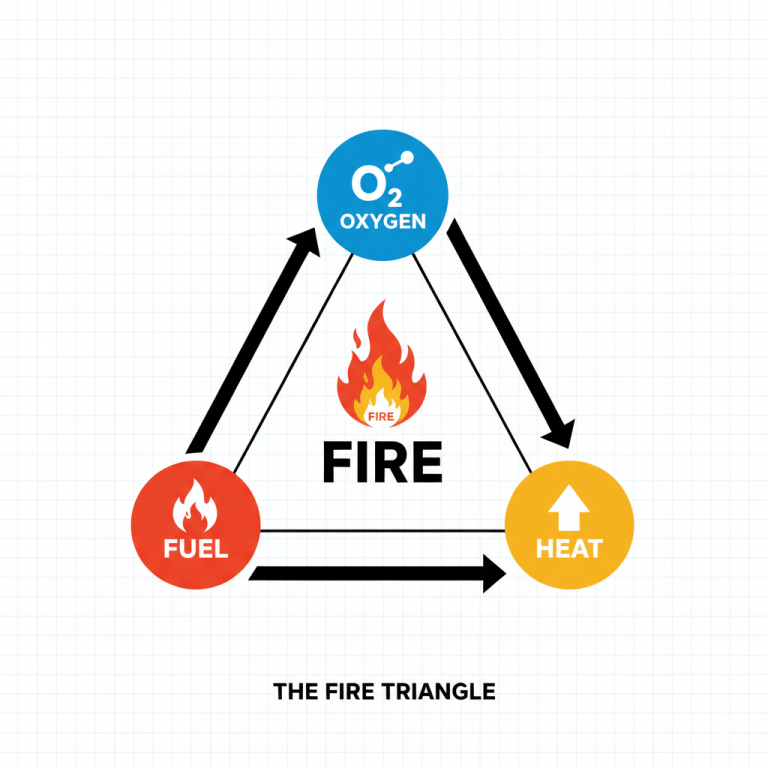
"The standard Fire Triangle requires three components: Heat, Fuel, and Oxygen. Traditional extinguishers work by removing one side (e.g., foam removes oxygen, water removes heat). The revolutionary inhibition technology of the Fire Safety Stick goes further: it adds a fourth component to create the Fire Tetrahedron, working at the molecular level to chemically interrupt the chain reaction that sustains the fire. This interruption is what makes the extinguishing process faster, cleaner, and more effective across multiple fire classes."
Corrosive Residue: Focus on the damage caused by powder extinguishers. Example: “Traditional dry powder extinguishers leave a residue that is highly corrosive, often causing more damage to sensitive electronics, engines, and interiors than the fire itself.”
Maintenance & Lifespan: Stress the hidden costs and maintenance headaches. Example: “Many conventional units require costly annual servicing and regular inspection tags, often expiring after 4-5 years, leading to replacement expenses.”
Visibility & Toxicity: Briefly touch upon the lack of visibility after use. Example: “Once activated, powder can severely impair vision, and the chemicals are often toxic and difficult to breathe.”
Aerosol Inhibition Technology: How the FSS Works


The Science of Fire Suppression: How the Fire Safety Stick Works
The Fire Safety Stick (FSS) is a manual, portable fire extinguishing device. It uses a Potassium ion jet (a unique method among conventional fire extinguishers) that works by interrupting a fire’s chain of reaction (the “auto-catalyst” of the fire).
Fire Safety Stick is composed of stable, solid minerals; it does not contain gas and is not pressurised. The aerosol-like jet is only produced when the charger is struck with its base. The produced aerosol jet is free of thrust and is essentially an inert salt that emits gas already present in the atmosphere.
The true measure of the device’s superiority lies in the speed and effectiveness of the Aerosol Inhibition Technology when faced with multi-class fires.

Best practices and uses.
Unlike a dry chemical extinguisher that combats a blaze by depositing a large amount of solid powder on the fire, the Fire Safety Stick fights a fire by releasing a gas.
This gas attaches itself to the oxygen surrounding the fire robbing its ability to stick to the chain of combustion (without affecting ones ability to breath that oxygen).
The goal is therefore to use the gas coming out the FSS to create a ‘cloud of containment’ around a fire. Creating a cloud that prevents any outside and un-attached oxygen from getting to the fire is essential and is the same strategy that should also be used with a Halon/Halotron or CO2 extinguisher.
The two worst things you can do when fighting a fire with a gas extinguisher are to be too close or to rush the process. Being very close to a fire means that a cloud cannot be formed, blocking any new oxygen that will continue to feed the flame. This is particularly problematic in an isolated pan situation, where being too close will only chase the flames around. Rushing the process by moving the extinguisher around a lot also prevents a cloud from being formed and diminishes the performance of the extinguisher.
The best technique is to take advantage of the long discharge time offered by the Fire Safety Stick and to approach a fire from a moderate distance, progressively getting closer to its source. During the approach, move the FSS slowly around the fire, always directing towards the centre. This will contain the fire and allow the gas the ability to work.
Tight areas with lots of pockets (like the engine bay of a car, for example) bring out the strengths of the FSS as the gas, which is heavier than air, will fill all the voids not directly accessible, both putting out a fire and preventing a re-flash.
Unlike a dry chemical extinguisher that combats a blaze by depositing a large amount of solid powder on the fire, the Fire Safety Stick fights a fire by releasing a gas. This gas attaches itself to the oxygen surrounding the fire, robbing its ability to stick to the chain of combustion (without affecting one’s ability to breathe that oxygen). The goal is therefore to use the gas coming out of the FSS to create a ‘cloud of containment’ around a fire. Creating a cloud that prevents any outside and unattached oxygen from getting to the fire is essential, and is the same strategy that should also be used with a Halon/Halotron or CO2 extinguisher.
The potassium-based aerosol system is available in a 100-second commercial vehicle fire extinguisher
For smaller applications, try our small fire suppressant stick, 50 Seconds
How the Fire Safety Stick Works: The Science of Potassium Ion Fire Suppression
This process allows the stick to extinguish all types of fires through saturation, while its slow biodegradation in the environment further reduces the likelihood of subsequent fires.
The extinguishing process involves two different reactions: one is physical and the other, chemical. The physical reaction relates to potassium ions (or Free Radicals) tendency to oxidise rapidly in air. When in contact with air, alkaline salts consume great quantities of oxygen, thus depriving fires of oxygen. Then the chemical reaction is created through the stable link between potassium particles and the fire’s combustion particles.
In the two reactions, a rapid oxidation process occurs, immediately transforming the jet from a solid to a gaseous state and freeing the potassium particles. These atoms are able to intercept and interrupt any other free particles produced by the fire’s natural chain reaction combustion process.
The true measure of the device’s superiority lies in the speed and effectiveness of the Aerosol Inhibition Technology when faced with multi-class fires.

Clean Science: Start by contrasting with the mess: “The Fire Safety Stick uses a non-toxic, solid compound that, when activated, releases a potent aerosol gas. This gas does not rely on smothering or cooling the fire.”
Molecular Interruption: Explain the ‘Inhibition’ mechanism. Example: “Instead, the aerosol chemically interrupts the combustion chain reaction at a molecular level.
It effectively breaks one side of the fire triangle, causing the fire to extinguish itself safely.”
Result: Emphasise the benefit. Example: “Because no corrosive powder or liquid is ever discharged, there is absolutely zero residue, preventing costly cleanup and secondary damage to equipment, engines, or interiors.”
- The true measure of the device’s superiority lies in the speed and effectiveness of the Aerosol Inhibition Technology when faced with multi-class fires.
Zero Maintenance, Zero Cost: The Fire Safety Stick's 15-Year Life
Comprehensive Multi-Class Fire Protection: A, B, C, F, and Electrical up to 100,000 volts
- The technical superiority and rapid action of the Fire Safety Stick are entirely due to the advanced Aerosol Inhibition Technology at its core.
All-In-One Solution: Emphasise that it replaces multiple specialised extinguishers. Example: “Most traditional extinguishers are limited to one or two fire classes. The Fire Safety Stick is a true all-in-one solution, effective on all major fire types.”
Breakdown of Classes: List the classes it covers and briefly explain the benefit:
Class A (Solids): For wood, paper, and fabrics (Homes, Caravans).
Class B (Liquids): For fuels, oil, and petrol (Cars, Boats).
Class C (Gases): (Where applicable).
Class F (Fats/Oils): Crucial for kitchens and catering.
Electrical (up to 100,000V): Safe for modern vehicles and workshops.